
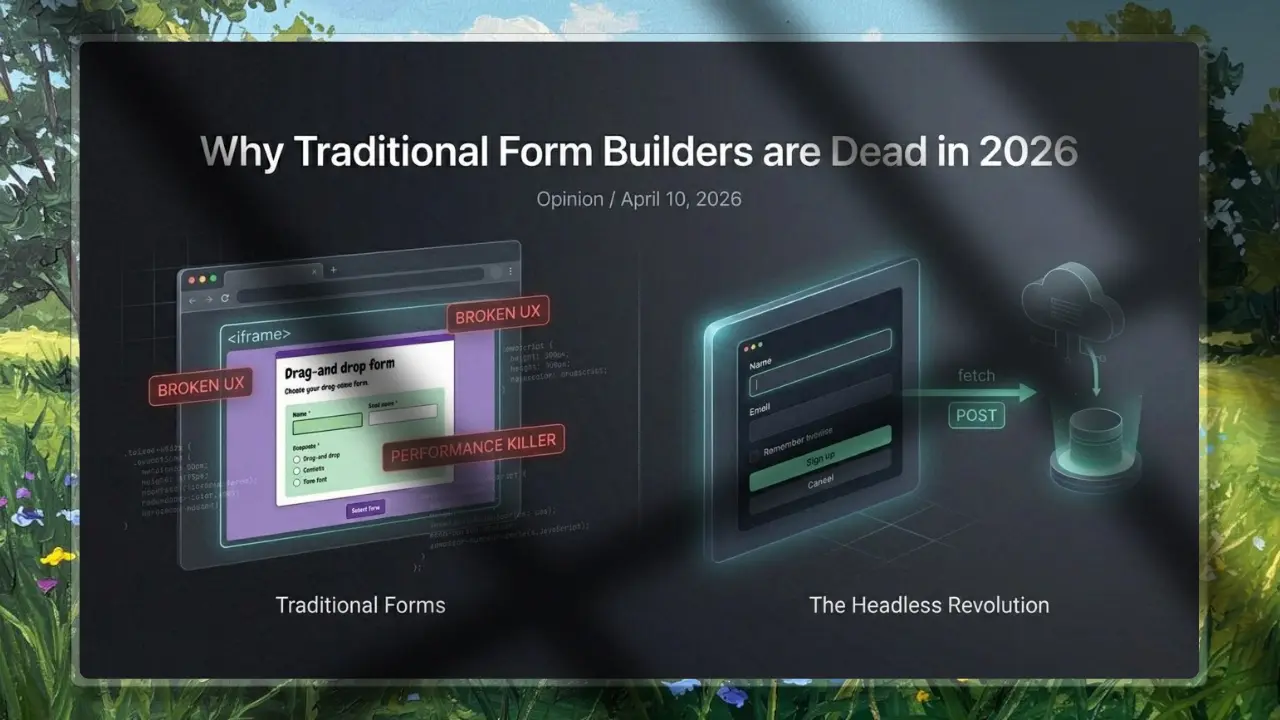
For over a decade, we've accepted a terrible compromise in web development: to collect user data, we have to ruin our user experience.
Tools like Typeform, Google Forms, and Jotform popularized the "drag-and-drop" era. They were revolutionary for their time, allowing non-technical teams to spin up surveys quickly. But in 2026, the cracks in this architecture are impossible to ignore.
The Iframe Problem
If you want to integrate a traditional form into your SaaS or marketing site, you are forced to use an <iframe>.
- It breaks your design system: You can never 100% match the form to your Tailwind theme, fonts, or micro-interactions.
- It kills performance: Iframes load entirely separate DOMs, downloading redundant JavaScript and CSS. This hurts your Lighthouse scores and core web vitals.
- It ruins tracking: Passing analytics events (like Facebook Pixel or Google Analytics conversions) from inside an iframe to your parent window is a nightmare of
postMessagehacks.
The Headless Revolution
The modern web is built on APIs. We use headless CMSs (like Sanity or Contentful), headless commerce (like Shopify APIs), and headless authentication (like BetterAuth).
Forms are the last piece of the puzzle.
By decoupling the presentation layer (your React/Next.js frontend) from the infrastructure layer (database, validation, spam protection, webhooks), headless forms give developers ultimate freedom.
You write the standard <input> tags, apply your own CSS, and simply fetch a POST request to a secure endpoint. That's exactly what we are building at Formix. The era of the iframe is over.